
Do you remember that scene in Jerry Maguire when the kid says, ‘The human head weighs 8 pounds’? Did you know that fact? I know I didn’t. Only 8 pounds! Wow.
Did you ever even think about it? Well, I looked it up, and it turns out the human head weighs between 5 and 11 pounds typically, but I never thought about it ’til that movie.
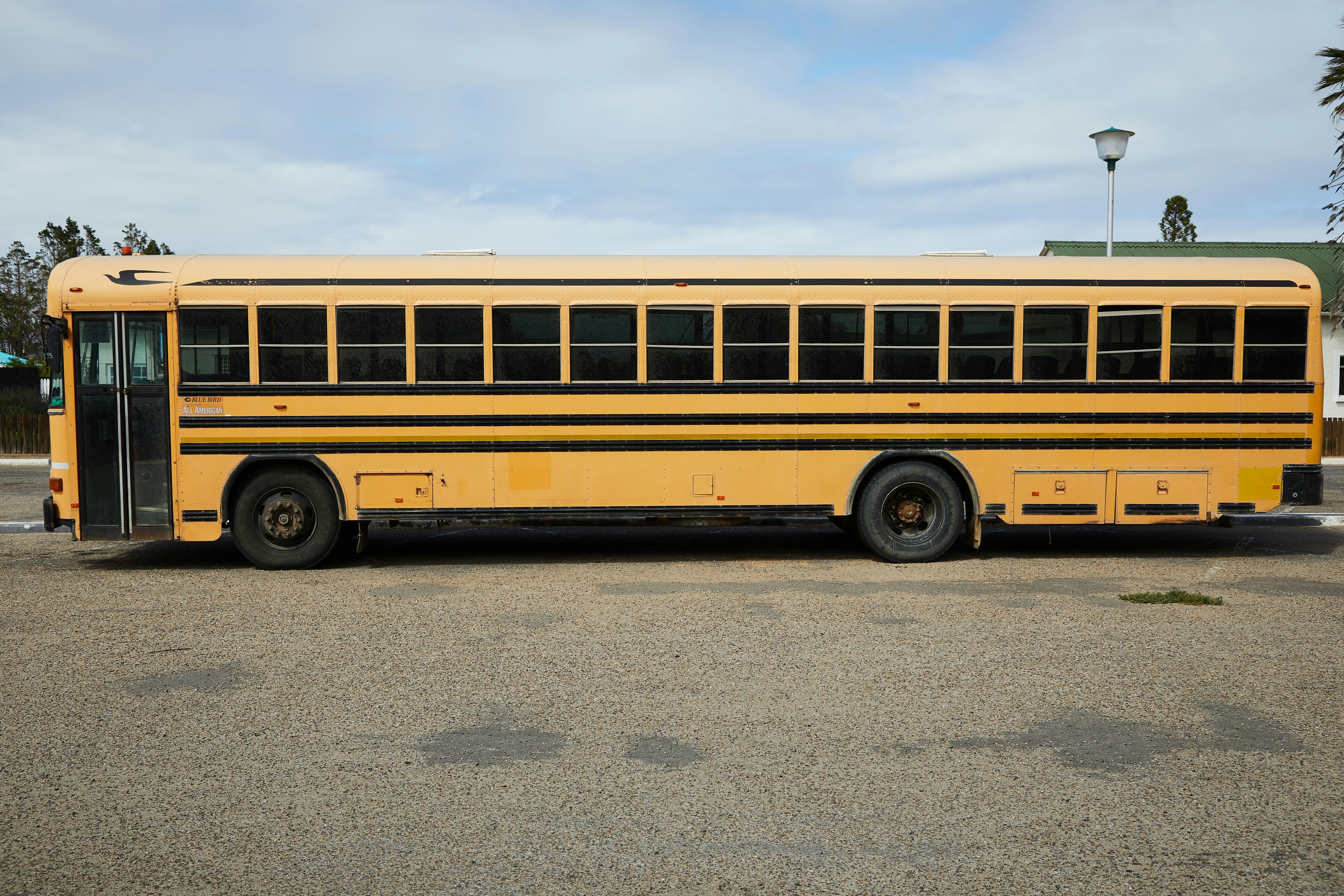
You know what else hardly crosses the mind? Even though you see them on the road every morning, there are safety precautions about them all the time. Big Yellow School Buses.
Do you know how much a school bus weighs? I know. The curb weight of the 1968 Mustang with a 289 engine weighs about 2758 lbs and can do 0-60 in about 7.3 to 8.3 seconds. What I don’t know (yet) is how the school bus stacks up against the Mustang.
I am now obsessed with finding out how the Giants like School Buses, Semi-Trucks, Pick Up Trucks, Electric cars, and Motorhomes compare. (mostly ’cause I want to make a bet on this next time I am at the car show).
The Showdown
Let’s take a quick look at how each vehicle class stacks up in raw weight, then compare them to one another:
School Bus Classes
Not all school buses are the same; they generally come in three different sizes, and these weights don’t include passenger weights:
- Short Bus: Smallest class, basically a bus on the base of a van chassis ( 10 to 14 thousand lbs
- Regular (conventional) Bus: This is a classic long nose (15 to 21 thousand lbs)
- Transit Style: The flat nose variety ( 25 to 33 thousand lbs)
For our purposes, we are basing our comparison on the Transit Style bus, weighing in at 15 tons or 30,000 lbs, as this is a very common type in use.
Just as a comparison, that’s approx. 2,875-4,125 times more than a human head. Yikes!

The Electric Car (e.g., Tesla Model 3 / Ford Mustang Mach-E):
First of all, who thought that Ford would end up having an electric car? Let alone their branded Mustang. Makes you wonder. Anyway, back to it.
A single school bus, when full of kids, weighs as much as eight to nine Tesla Model 3s.
The American Pickup Truck (e.g., Ford F-150):
That yellow bus tips the scales at the equivalent of roughly six or seven fully-loaded F-150s.
A Standard Passenger Car (e.g., Toyota Camry / Honda Civic):
To equal the mass of one school bus, you’d need to line up over ten Honda Civics.
A Transport Truck (Semi-Truck Tractor):
Comparing a bus to a loaded semi would be too variable depending on cargo, so for this example, we are using the weight of the tractor unit ( without trailer). This weighs about 17 to 25 thousand lbs, and a loaded bus can actually outweigh a semi tractor.
Last but not least,
Large Motorhome (Class A):
A large class A motorhome (12 to 30 thousand lbs) would be about the same weight as a bus, but the damage to the motorhome might be more severe due to its different construction.

Why All This ‘Weight’ Matters on the Road
In many European countries, the buses used for school transport look and function more like standard public-transit vehicles or compact minibuses. They typically follow the same design language as regional buses—neutral colors, lighter frames, and interiors that prioritize seatbelts rather than heavily reinforced structure. Because school transport in Europe often covers shorter distances and mixes with dense urban traffic, the vehicles are optimized for efficiency, maneuverability, and adherence to local traffic norms rather than a single unified design.
This is quite different from the American approach. In the U.S., school buses are instantly recognizable: large, bright yellow, and built with reinforced steel bodies that act like a protective shell. Instead of relying mostly on seatbelts, American buses use compartmentalized seating and the sheer weight of the vehicle to absorb impact. They also include mandatory stop-arms, flashing lights, and federally standardized safety features that don’t exist in most European countries. These design and regulatory differences don’t just change how the buses look—they affect braking, crash behavior, visibility, and the overall safety philosophy behind school transportation.
The weight of a vehicle affects the stopping distance and the impact in a collision:
A bus weighing 30,000 lbs might require the length of a basketball court, whereas an F-150 truck only weighs 47,7400 lbs, so stopping distance is much shorter. The energy of the bus and how fast it was travelling might feel like it was trying to drive through that truck and into next week. Like a bicycle being hit by a car, not a fair fight at all.
When it comes to School Bus safety, these weights are important to be able to understand why a school bus accident can be so devastating.
The center of gravity can be higher, and the weight, combined with sudden swerves and cutting the wheels, can cause it to tip. All that weight dragging along the ground can make injuries worse.
Laws surrounding the liability and compensation in these complex cases can be confusing, and they also vary by jurisdiction.
For example, in a busy, multi-school district like Chicago, going through the aftermath of a school bus incident will require special knowledge and someone local (and experienced) to give you guidance. In this situation, a Chicago school bus accident lawyer could explain Illinois state laws and help you know your rights (if your child was on the bus or even if a bus hit you).
But if you’re in a city like Houston, Texas, a Chicago lawyer won’t do you any good. This is due to the fact that the laws in Texas are completely different. Texas has very strict governmental immunity rules, which means that such a school bus case would require a formal notice of claim within 6 months (in some school districts, this is 45-90 days only!).
And you need someone local to know all these differences; otherwise, you won’t have a case at all, and the opportunity is going to go by you as fast as that Tesla Model 3 (it’s unfortunately a tad bit faster than the Mustang).
Conclusion
The moral of our story is to bet on the school bus for the win.
It looks like a bus, which might be associated with small children, can pack a big punch, so always follow the rules with a bus cause if it came to fistycuffs, you might lose.